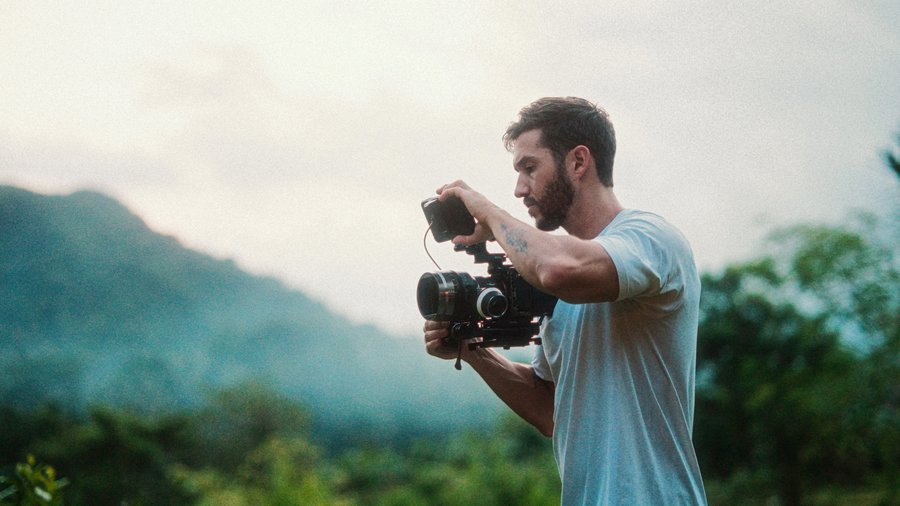
Every sound in the short film sequence above was added in post. All of it. I'm going to show you how I built that entire sound environment, layer by layer. This one was by request: I asked in my community tab what topic you wanted next, and a whopping majority chose sound design. (Sorry to the iMovie users who wanted that tutorial. Maybe in the future.)
Set up audio roles and lanes first
My timeline is layers upon layers, so organization matters. Select sound effects, right-click, Assign Audio Roles, and create your own roles via Edit Roles. Mine: Foley (technically not all true foley, but it's my bucket for direct sound, the main action you're hearing, like a punch landing; usually louder and near the top under the primary storyline), Ambience (background environment), Effects (risers, hits, drones), plus dialogue and music.
The three little buttons on each role in the timeline index: one collapses every other role, one expands the sublevels inside a role, and one drops each role into its own dedicated audio lane so everything organizes itself. You can reorder lanes however you like, add sub-roles, and recolor them (though Apple only gives you muted earth tones, which, oh well).
Ambience: fill the environment
Ask yourself: if you were standing in this shot, what would you hear? For my desert scene, that's wind and a little sand moving across the dunes. Ambience should sit at a lower level; it's felt more than noticed. Without it, everything sounds hollow.
Effects: risers, hits, and drones
When I change clips, I like a sound that punctuates the change. Risers (sounds that continually build in volume and usually pitch) lined up to end exactly at the cut make transitions pop, especially into silence, where the stop itself is shocking. I layer in drones at different frequencies for an eerie base mood, shimmer effects for a creepy high-pitched edge, and low bass hits for weight. None of it is music; it's mood. I even doubled a musical riser with drone strings to accentuate the same build.
Foley: constructing the direct sound
This is arguably the most important layer, because you're constructing exactly what the viewer expects to hear. For a group walking, I layered multiple footsteps-in-dirt-and-gravel effects offset in time so it sounds like several people. For a door being broken open, I stacked a Beretta sound (sounds like a lock breaking off), a refrigerator door, a car door opening, and wood crashing. Individually they're wrong; together they're the door. Clothing movement is the most overlooked one: a guy reaching for a door in a heavy suit would make noise, so give him some.
And get creative. My favorite lesson, which I learned from Brandon Li: an unrelated sound effect at low volume often sells better than the "correct" sound at high volume. A man falling in my film is actually a tree falling, played quietly, layered with dirt and sand. A ratchet click, duplicated a few times (Option-drag to quick copy), became something else entirely. If you can see it in the shot, like sand kicking up, add a little of it even if it technically wouldn't be audible. It sells the image.
Surround sound and pan modes
Before any of this: change your project to surround. Click your project, open the inspector, hit Modify, and under Audio switch from stereo to Surround. You'll get six lanes in your audio meters (click the meter bars to open them; my buddy Matthew O'Brien, the other Final Cut Pro editor, taught me you don't need Shift Command 8).
Surround unlocks Pan Mode in the inspector. Don't get flustered by all the options: the two you need are Create Space and Ambience. Create Space is for sounds you want positioned in the scene: a sneaker to the left of frame gets panned left. Add keyframes and you can move a sound across the frame as the subject moves. Also: stereo clips only hit the left and right channels; switching their pan mode to Create Space spreads them across all six, including the LFE bass channel.
Audio effects as storytelling
Someone walking up outside while your character is indoors? Put the Muffled effect on those footsteps and they read as "outside the door." For the shell-shocked slow motion moment, I used the Underwater effect on the ambience, garbled and distant like the movies, with a bass hit accentuating each shell casing dropping. A boombox in a room got a Cathedral effect over the music so it sounds like it's playing in the space, not on the soundtrack. (You can also do the Shift H hold-frame trick from my buddy Dylan, The Final Cut Bro, and effect just the frozen moment.)
Cuts, match cuts, and J-cuts
Sound can carry you between shots. A sand-blast overlay at the end of one shot continuing into sand in the next acts as an audio match cut. Hits and swooshes placed right on a cut accentuate it (mine was a "glass hollow swoosh" from Soundsnap). And the J-cut: start a sound before its shot appears. I ran a fighter jet sound almost the whole way through the previous clip, priming you for the plane and making a hard cut feel smooth. The jet, by the way, was layered with a jetpack effect for the missile and radio chatter on top.
Levels, fades, and not peaking
Audio is additive. Stack enough clips and you'll peak, which is exactly what happened to me in this film's finale. Start your clips around -10 to -12 dB and raise only what needs to stand out. If you've already peaked, compound clip the whole thing and pull it down or add a limiter. And fade everything: drag the little fade handles on each clip so layers ease in and out instead of slamming. Right-click a fade handle to change the fade curve, from gradual to loud-out-the-gate.
Where I get sound effects
YouTube is number one: free, and it has almost everything. For specialized stuff, Soundsnap (paid) is my go-to. Artlist and Envato Elements both have fantastic libraries too.
The recap
Imagine you're in the scene. What would you hear directly in front of you (foley)? What's around you (ambience: wind, traffic, birds)? Then add effects: risers and hits between shots, a drone or high-pitch layer for mood. Switch your project to surround so you can pan and animate sounds around the listener. Start layers low and raise what matters. And get creative: the "wrong" sound at the right volume works more often than you'd think.
The full cinematic toolkit
Sound is half the experience. The FCP Color Grading Masterclass teaches the other half: professional color from correction to finished look. Featured on Apple's official Final Cut Pro Resources page.
Explore the Color Grading Masterclass